
The End-to-End Accuracy Solution for Credit Union Credit Reporting and Dispute Oversight

Data Quality Scanner helps credit unions monitor Metro 2® furnishing accuracy, dispute-response quality, and member-impact patterns across lending and servicing operations.

DQS connects furnishing oversight with dispute review so teams can find recurring issues, prioritize the accounts that need attention, and support cleaner documentation before problems spread across member populations.

Built on proven DQS monitoring, the platform supports investigation, review, and operational control while keeping human decision-making central.
What Credit Union Teams Are Managing Now
Credit unions are managing credit reporting and dispute risk across member accounts, core systems, loan products, and lean operating teams.
  • Furnishing Complexity Metro 2® issues can affect member accounts across fields, products, reporting cycles, and system records.
  • Dispute Pressure Repeat disputes and response-quality gaps need review across more than a small manual sample.
  • Exam Readiness Teams need clear issue history, correction status, and documentation before exam, audit, or complaint review.
  • Merger Data Quality Mergers can expose reporting differences, field mismatches, and system-of-record alignment gaps.
  • Lean-Team Oversight Lean teams need faster clarity on what changed, which accounts are affected, and what to review first.

Data Quality Scanner

How the DQS Product Family Supports Credit Union Reporting and Dispute Oversight

Furnishing Module New Release

Furnishing Oversight for Credit Union Credit Reporting Accuracy

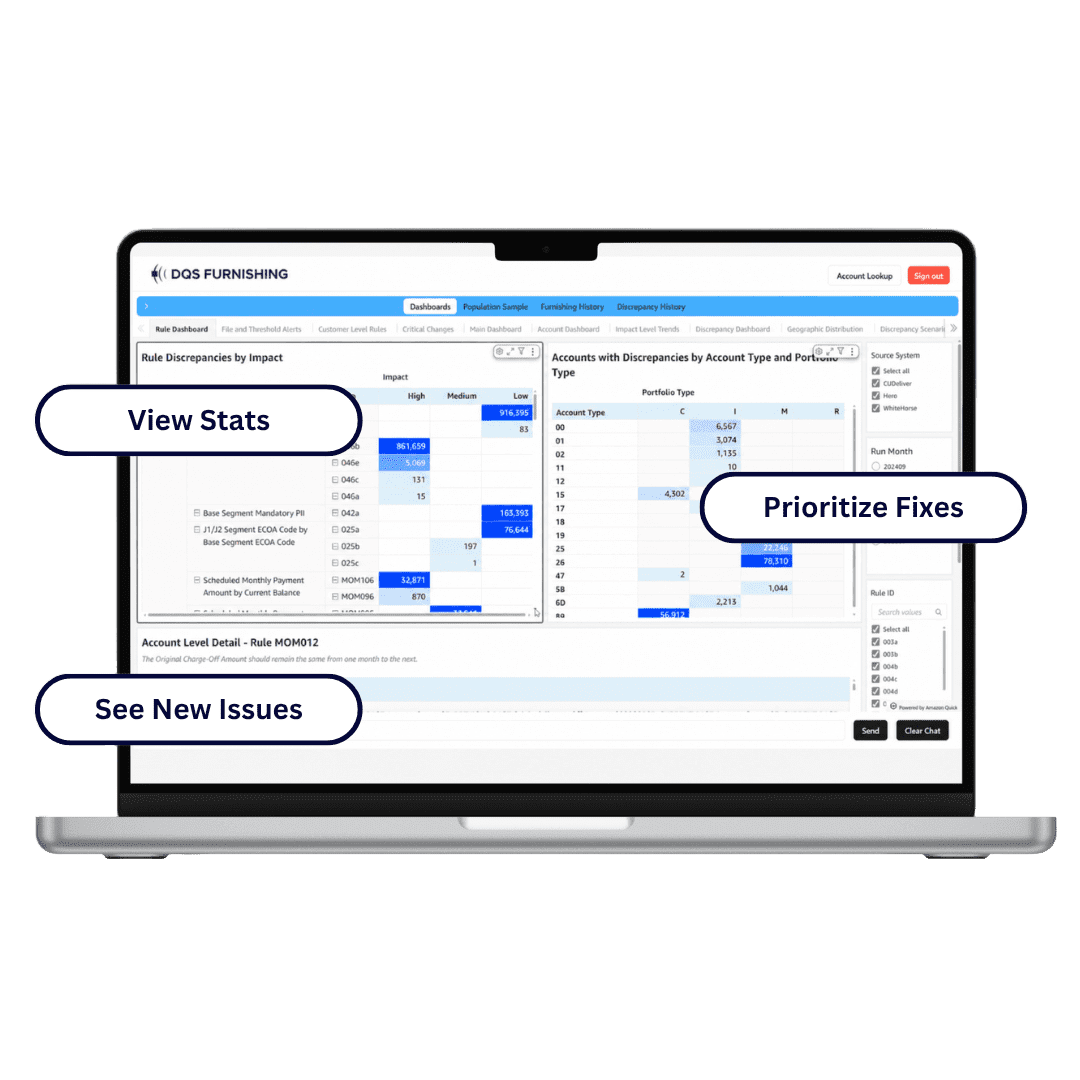
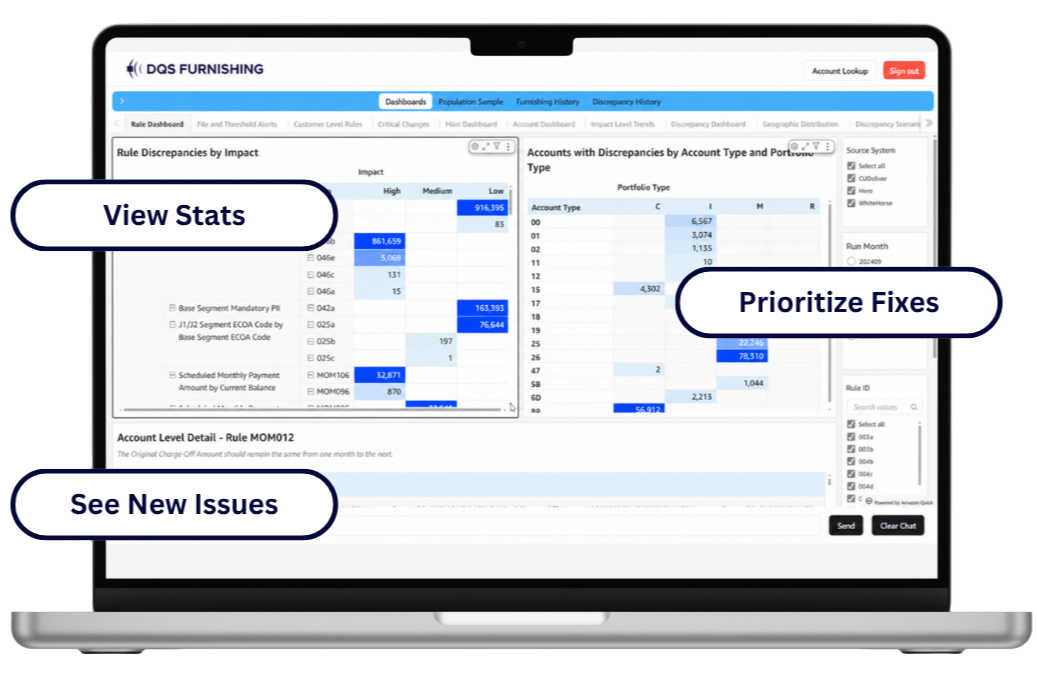
The Furnishing Module helps credit unions evaluate Metro 2® credit reporting accuracy across furnished member accounts before or after furnishing. It reviews furnished data against risk-ranked rules and alerts so teams can find reporting patterns, affected member populations, and merger or conversion data-quality issues earlier.
Find
Surface Metro 2® discrepancy patterns across furnished member accounts, products, reporting cycles, and merger-related data sets.
Prioritize
Understand which rules, fields, accounts, and member populations need review first.
Fix
Support corrective-action planning, exam preparation, and merger-related data review with clearer issue history.
New Release Furnishing Module Optional AI Research Assistant support is available for deeper furnishing investigation.

BUILT ON THE PROVEN DQS FOUNDATION

These documented Data Quality Scanner outcomes establish the proven performance foundation behind DQS for furnishing accuracy, dispute oversight, and credit union reporting control.

Rules & Alerts
400+

Risk-ranked rules and alerts across Metro 2® furnishing data quality

Furnishing Monitoring
100%

Furnished data monitoring across the full reporting population

Furnishing Accuracy
90%

Up to 90% reduction in furnishing discrepancies

Dispute Oversight
100%

Full-population dispute oversight beyond manual sampling alone

Dispute Quality
80%

Up to 80% reduction in unresolved dispute discrepancies

Based on documented outcomes. Results vary by institution, operating model, and scope.

Review Credit Union Credit Reporting and Dispute Readiness Before Data Issues Become Bigger Risks

For credit union teams responsible for Metro 2® furnishing accuracy, dispute readiness, documentation, or reporting oversight, this conversation can help identify member-account reporting priorities before they become harder to manage.

Discuss exam preparation, merger-related data checks, dispute oversight, and clearer prioritization across member-account reporting with the Bridgeforce Data Solutions team.

Discuss Credit Union Product Fit

Enter your information below to discuss reporting and dispute priorities with our team.

We do not sell or share your information.

Why the Market Has Changed

Credit unions are managing credit reporting in a more complex oversight environment. As FCRA lawsuits, complaint activity, dispute pressure, and documentation expectations increase, teams need clearer visibility into what changed, which member accounts are affected, and what should be reviewed first.

FCRA lawsuits and complaint activity are rising across the credit reporting market, increasing the need for clearer furnishing oversight, dispute-response quality, and documentation control.

Metro 2® furnishing issues, bureau changes, unresolved corrections, and response-quality gaps can create repeat disputes, escalations, operational drag, and member-impact risk.

Lean credit-union teams need clearer issue history, affected-population visibility, and documentation support before exam, audit, or complaint review.

Mergers and system changes can expose reporting differences, mismatched fields, changed account histories, and system-of-record alignment gaps.

AI-assisted and templated dispute submissions are increasing, making it harder for credit union teams to separate genuine member data issues from repeat or automation-driven activity.

FCRA LAWSUITS
8,000 6,000 4,000 2,000 0 2014 2017 2020 2023 2025 FCRA litigation continues to rise
FCRA RELATED COMPLAINTS
6 MM 4 MM 2 MM 0 2020 2022 2024 2025 FCRA complaint pressure continues to rise across CFPB and FTC
Sources: WebRecon; CFPB Consumer Response Annual Reports; FTC Consumer Sentinel Data Book.

The Core Problem

Credit unions need to identify and resolve credit reporting data-quality issues before they become repeat disputes, examination findings, member escalations, operational drag, or legal exposure. The practical challenge is answering three questions clearly across furnishing and dispute activity: what changed, what is driving the issue, and what should be fixed first.

What Changed
Teams need to see what changed, which member accounts are affected, and whether the issue came from furnishing activity, a system change, or a reporting shift.
What Is Driving the Issue
Teams need clearer visibility into which rules, fields, or repeated account patterns are driving the issue so root-cause analysis can start sooner.
What Should Be Fixed First
Managers need to see where risk is concentrated so review and corrective action can focus on the highest-impact issues first.

When investigation tools are too static or difficult to navigate, teams spend too much time finding the problem and not enough time correcting the root cause. That raises operating cost, slows resolution, and limits a team’s ability to prioritize corrective work effectively.

Common Credit Union Use Cases

Data Quality Scanner helps credit unions review Metro 2® furnishing accuracy, monitor dispute-response quality, identify affected member populations, support merger-related data review, and prepare for exam or complaint review.

1

Furnishing Accuracy and Affected Member Population Review

Identify recurring Metro 2® furnishing discrepancies, the rules or fields driving them, and affected member populations across products or account groups.

2

Dispute-Response Quality and Repeat Issue Monitoring

Monitor dispute-response quality, unresolved corrections, analyst-created discrepancies, and repeat dispute patterns that may require stronger management review.

3

Exam, Complaint, and Documentation Review Support

Support review of issue history, Metro 2® furnishing patterns, dispute handling, corrective-action decisions, and documentation before exam or complaint review.

4

Merger and System-of-Record Data-Quality Review

Review data-quality patterns before, during, or after merger activity where system alignment, account migration, and reporting consistency need clearer oversight.

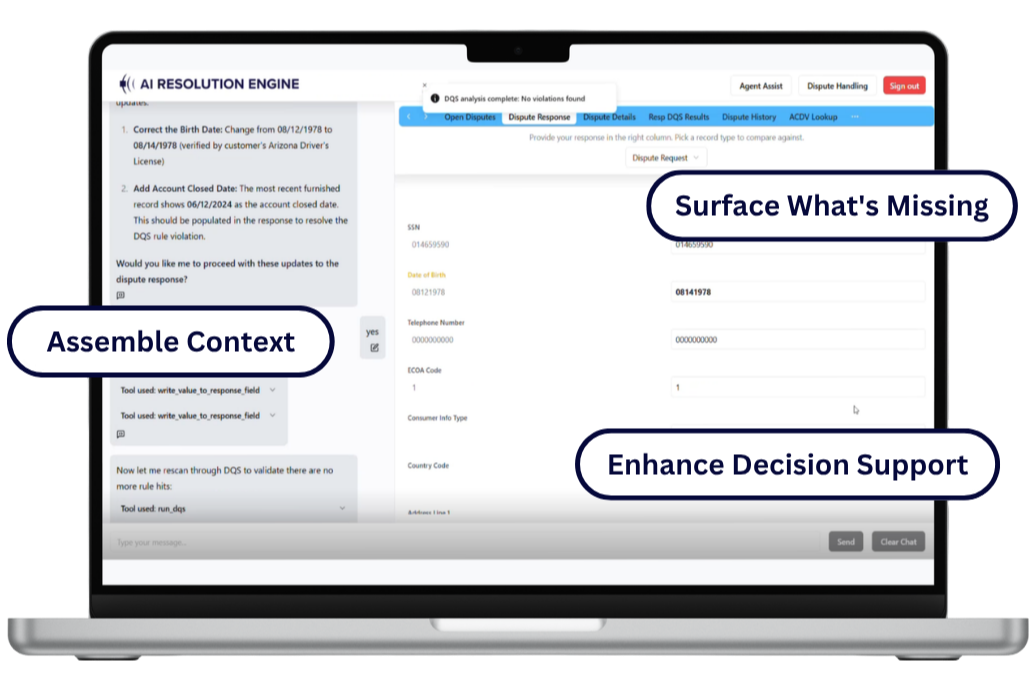
Where enabled as an optional premium add-on to the Furnishing Module, the AI Research Assistant can support account research and pattern review. The AI Resolution Engine, currently in pilot, can support dispute context, evidence assembly, and analyst-facing decision support. Human review remains central before corrective action, dispute responses, or remediation steps are approved.

Credit union product fit
Discuss Product Fit

Ready to review how these credit reporting and dispute oversight issues may apply to your credit union?

Business Value for Credit Unions

DQS helps credit unions identify and resolve credit reporting issues before they create repeat disputes, member complaints, exam questions, or merger-related reporting risk - strengthening furnishing accuracy, dispute oversight, exam readiness, and data-quality review.

Earlier visibility into Metro 2® reporting issues before they drive member disputes, complaints, or legal exposure
Full-population review of disputed accounts and dispute analyst responses beyond manual sampling
Clearer furnishing-to-dispute visibility when member disputes point back to upstream reporting issues
Stronger exam readiness through clearer issue history, response documentation, and correction visibility
Merger and system-of-record review support before reporting differences become harder to isolate

Credit union teams remain responsible for reviewing findings, prioritizing action, directing corrections, and approving how credit reporting and dispute-response issues should be handled within their governance and quality standards.

Frequently Asked Questions

How does DQS support credit unions?

DQS helps credit unions review furnishing accuracy, dispute-response quality, repeat issue patterns, documentation, and merger-related data quality across member-account populations.

By connecting furnishing oversight with dispute review across the full disputed-account population, DQS supports affected member population analysis, repeat issue monitoring, exam preparation, documentation review, and system-of-record alignment.

Credit union teams remain responsible for reviewing findings, prioritizing action, directing corrections, and approving next steps within their own governance and quality standards.

How does DQS help with Metro 2® furnishing accuracy?

The Furnishing Module helps teams review Metro 2® data quality, rule patterns, and affected member populations.

It reviews furnished data using over 400 risk-ranked rules and alerts, helping teams identify discrepancy patterns, affected member populations, and merger or conversion data-quality issues before exams, audits, or system integration.

For organizations that want deeper account-level investigation, the optional premium AI Research Assistant adds account lookup screens and plain-English research support to help users investigate discrepancies and related patterns more efficiently.

How does DQS help with dispute-response quality?

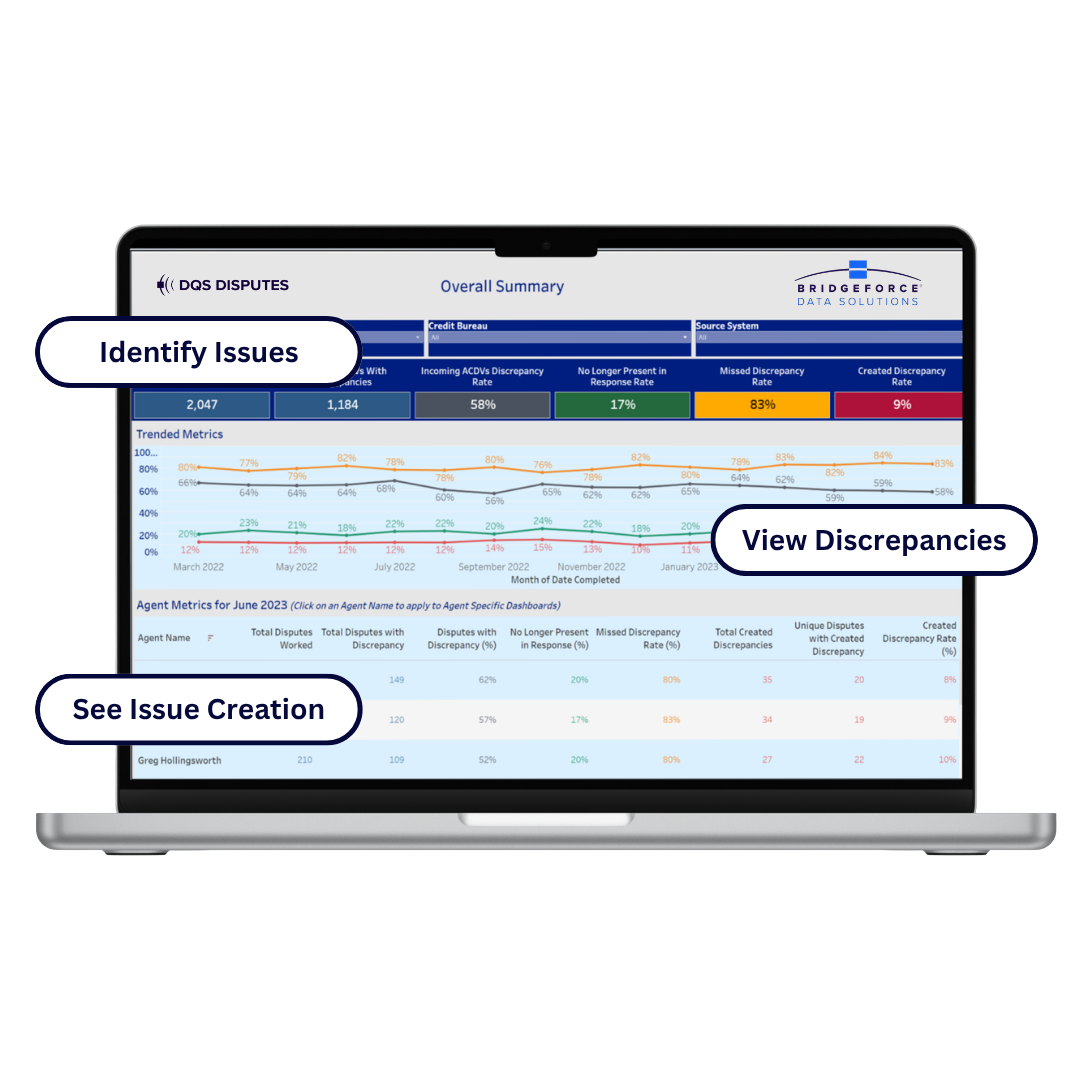
The Disputes Module reviews every disputed account and dispute analyst response using DQS rules, Metro 2®, ACDV, and AUD data.

It helps surface unresolved corrections, analyst-created discrepancies, response-quality gaps, and repeat dispute patterns.

The module identifies data issues in disputes, data issues caused by credit bureau transformations, and analyst-created discrepancies, providing stronger oversight without relying on manual sampling alone.

When paired with the Furnishing Module, it provides a more complete view of how upstream furnishing issues drive downstream disputes and responses.

Can DQS support FCRA exams and internal review?

Yes. DQS gives credit unions clearer visibility into issue history, response consistency, correction status, and documentation needed for FCRA scrutiny, exams, and internal quality review.

The platform supports stronger documentation and consistency by tracking dispute-response patterns, analyst changes, correction history, and recurring issue patterns.

Where the AI Resolution Engine is enabled, it can support documentation review and case context by assembling dispute history, documentation, images, and procedures into a more complete case view before responses are submitted.

How can DQS help during mergers or system changes?

DQS helps credit unions review reporting differences, affected member populations, and system-of-record alignment before and after merger integration.

Mergers and system changes can expose reporting differences such as mismatched fields, changed account histories, inconsistent populations, or records that no longer align cleanly.

DQS supports data-quality review before, during, or after merger activity where system alignment, account migration, and reporting consistency need clearer oversight.

How does the AI Resolution Engine support dispute review?

The AI Resolution Engine is an in-pilot capability that supports credit union dispute teams by assembling dispute history, documentation, images, procedures, and DQS findings into a more complete case view before responses are submitted.

It is designed as analyst-facing decision support for evidence review, documentation consistency, response-quality review, and governed dispute handling.

Human review remains central. Credit union teams retain decision authority, and any controlled automation must be limited to approved populations, controls, and validation standards.
The AI Resolution Engine is currently in pilot.

Is DQS a heavy IT implementation?

No. DQS is designed as a light, low-IT solution that does not require heavy direct integration to begin delivering value.

Client file-transfer processes can remain substantially the same, with secure delivery through established channels.

IT support is generally limited to practical enablement items such as whitelisting new Bridgeforce Data Solutions URLs for the user interface and updating file-naming conventions where needed to support automation.

DQS is designed to support a lower-lift path to credit reporting and dispute oversight compared with heavier system-change projects.

Who Data Quality Scanner Supports at Credit Unions

01

Credit Reporting and Dispute Operations Teams

Credit bureau reporting managers, dispute managers, FCRA QC leads, credit reporting specialists, loan servicing managers, and consumer lending operations teams.

Faster investigation across furnished and disputed member accounts, clearer visibility into affected populations, stronger root-cause review, and a more efficient way to understand what changed, which member accounts are affected, and what should be reviewed first.

02

Current DQS Customers

Current Furnishing Module or Disputes Module clients evaluating the new Furnishing Module release, optional AI Research Assistant support, or AI Resolution Engine pilot access.

Extends a proven DQS deployment with stronger furnishing investigation, continuing dispute oversight value, and a clear path to optional AI-assisted capabilities — including AI Research Assistant support for deeper furnishing investigation and AI Resolution Engine support for dispute review.

03

Compliance & Risk Leaders

Directors of compliance, lending compliance VPs, and first-line-of-defense risk leaders responsible for FCRA readiness, exam preparation, and documentation oversight.

Stronger operational control, full-population monitoring across furnishing and disputes, clearer documentation visibility, a governed path to AI-assisted review, and stronger support for FCRA exams, audits, and internal quality review.

04

Executive Buyers

Chief lending officers, SVPs of consumer lending, VP credit leaders, and senior lending executives evaluating credit reporting oversight, dispute risk, and AI readiness.

A stronger furnishing and dispute oversight platform, deeper investigative visibility, and a clear path to governed AI-assisted review built on a proven DQS foundation — with human review central to decisions.

What Credit Union Teams Say About DQS

Credit unions are one of Bridgeforce Data Solutions’ largest client communities, including 8 of the 10 largest credit unions in the United States. If you would like a regional referral or want to hear from a credit union team in your area, we can help connect you .

2026 CDIA Platinum Sponsor

Strengthen Credit Reporting Oversight Before Reporting Issues Affect Member Credit Scores

Data Quality Scanner helps credit union teams surface Metro 2® furnishing issues, affected member populations, dispute-response quality concerns, repeat issue patterns, and documentation gaps before reporting issues spread or become harder to explain.

For credit union teams managing furnishing accuracy, dispute-response quality, exam preparation, or merger-related data review, Bridgeforce Data Solutions can help review what changed, which member accounts are affected, and what should be prioritized first.

AI-assisted capabilities support review, investigation, and documentation while credit union teams retain control over decisions, responses, and corrective action.

What the Review Can Cover
  • Metro 2® furnishing discrepancy patterns and affected member populations
  • Repeat disputes and dispute-response quality concerns
  • Exam-readiness, documentation, and oversight gaps
  • Merger-related data-quality and system-alignment concerns

Request Credit Union Oversight Review

Share your furnishing, dispute, and member-account reporting priorities, and our team will follow up with next steps.

We do not sell or share your information.