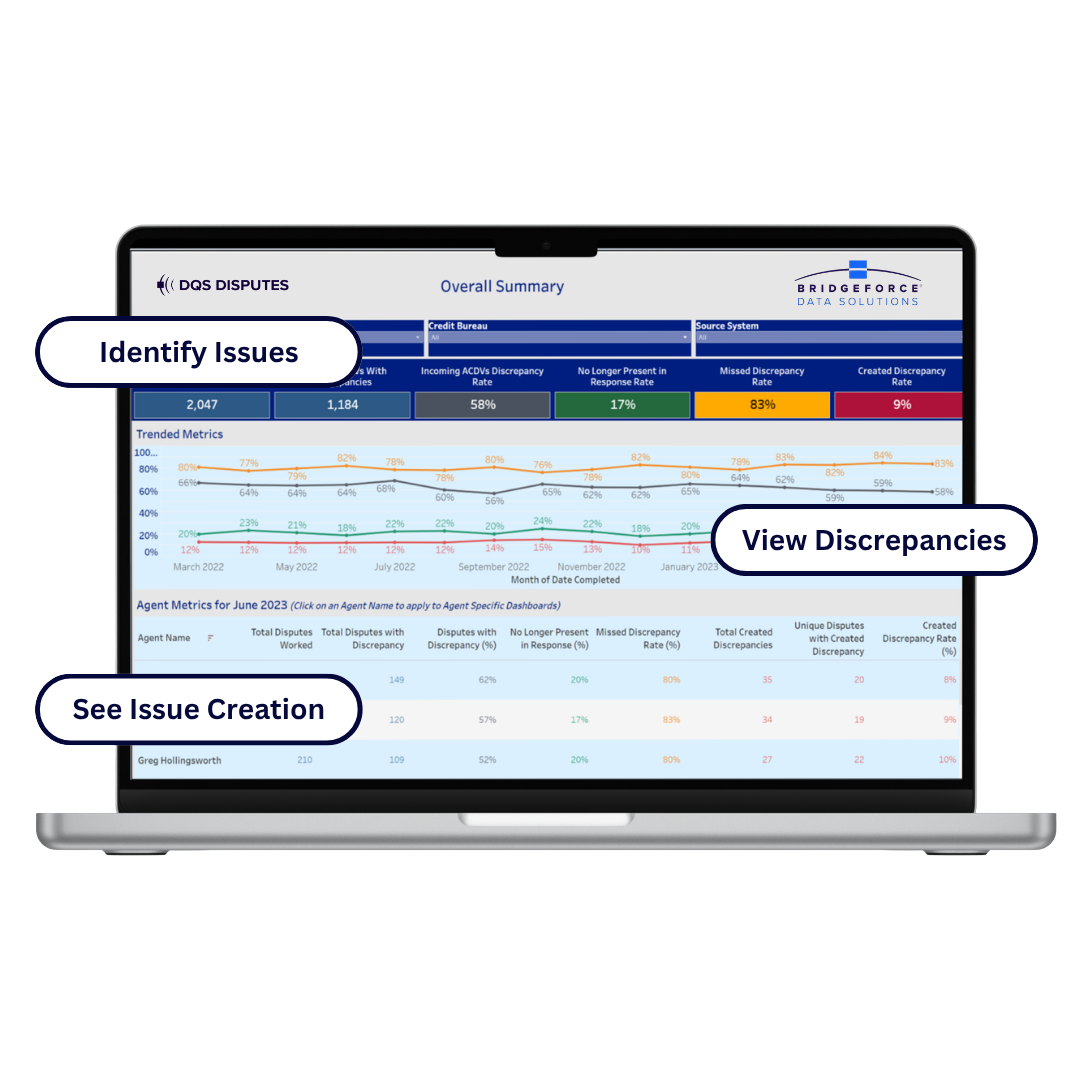
Disputes Module

Dispute Oversight and Response-Quality Review Across Every Disputed Account
The Disputes Module evaluates every disputed account and all dispute analyst responses for data quality and response quality.
It surfaces unresolved corrections, analyst-created discrepancies, differences between furnished and bureau-reported data, and response-quality gaps often missed by manual sampling.
Why Dispute Oversight and Response-Quality Review Have Changed
Furnishers need stronger oversight of every disputed account and every dispute analyst response — and clearer visibility into the data quality and response-quality issues that drive repeat disputes, complaints, and FCRA lawsuit exposure.
  • Repeat disputes and rising complaint volumes are increasing pressure on response quality and documentation
  • Manual sampling alone misses response-quality gaps across disputed accounts and dispute analyst responses
  • Analyst responses can introduce new discrepancies or leave existing corrections unresolved
  • Differences between furnished data and bureau-reported data are harder to track at scale

What the Disputes Module Is

What it is

Disputes Module evaluates every disputed account and all dispute analyst responses for data quality and response quality. It uses DQS rules and Metro 2®, ACDV, and AUD data to identify unresolved corrections, analyst-created discrepancies, dispute-response patterns, and differences between furnished and bureau-reported data.

Full-Population Dispute Review
  • Evaluates every disputed account and all dispute analyst responses
  • Extends review beyond manual sampling alone

Response-Quality Oversight
  • Surfaces unresolved corrections and response-quality gaps
  • Surfaces analyst-created discrepancies and repeat-dispute patterns
Root-Cause Visibility
  • Surfaces dispute-response patterns and differences between furnished and bureau-reported data
  • Supports clearer training, remediation, and oversight decisions

BUILT ON PROVEN DQS FOUNDATION

These documented Dispute Module outcomes establish the proven performance foundation behind the Disputes Module.

Complete Monitoring
100%

Monitoring of dispute analyst responses

QA Coverage
100%

QA review coverage increased from approximately 10% to 100%

Research Efficiency
15min

Certain research efforts reduced from roughly 3 hours to 15 minutes

Dispute Resolution Quality
80%

Up to 80% reduction in unresolved dispute errors that lead to repeat disputes and FCRA complaints

Process Overview

How It Works

The Disputes Module reviews every disputed account and all dispute analyst responses using DQS rules, Metro 2® data, ACDV data, and AUD data. It helps teams identify what changed, what remains unresolved, and where response quality, correction, or coaching needs attention.

1

Review every disputed account and all dispute analyst responses

Review dispute activity across the full population instead of relying only on manual QA samples.

2

Identify unresolved corrections and how data changed through bureau handling

Track how furnished data changes through bureau handling and where corrections remain unresolved.

3

Surface analyst-created discrepancies and response patterns

Identify new issues created in responses, repeat-dispute patterns, and analyst-response quality gaps.

4

Review findings and guide next actions

Review findings, prioritize issues, and guide training, correction, remediation, or oversight decisions within existing governance standards.

Why the Market Has Changed

Credit reporting disputes now operate under sustained legal, regulatory, customer, and operational pressure. As FCRA complaints and litigation rise, dispute oversight requires clearer visibility into what changed as data moves from furnishing through bureau reporting and dispute response.

Rising FCRA lawsuits and complaint volume are increasing pressure on dispute handling and response quality.

Many disputes arrive with identifiable data issues that must be understood before response quality can be reviewed.

Missing information, limited prior furnishing history, and differences between furnished and bureau-reported data make it harder to confirm what changed.

Manual sampling misses unresolved corrections, analyst-created discrepancies, and repeat dispute-response patterns.

FCRA LAWSUITS
8,000 6,000 4,000 2,000 0 2014 2017 2020 2023 2025 FCRA litigation continues to rise
FCRA RELATED COMPLAINTS
6 MM 4 MM 2 MM 0 2020 2022 2024 2025 FCRA complaint pressure continues to rise across CFPB and FTC
Sources: WebRecon; CFPB Consumer Response Annual Reports; FTC Consumer Sentinel Data Book.

The Core Problem

Dispute teams need to answer a small set of questions consistently: what was wrong on receipt, what changed before the response, and whether the response corrected the issue or created a new one.

What Was Wrong on Receipt
Disputes may arrive with furnishing discrepancies, missing information, or other data issues that need to be understood before response quality can be evaluated.
What Changed Before the Response
Teams need visibility into prior furnishing history, dispute history, and how data changed between furnishing and bureau reporting to understand what changed before the response was submitted.
What the Response Created or Resolved
Responses may correct the issue, leave corrections unresolved, or introduce new discrepancies that drive repeat disputes.

Without full-population visibility, teams miss unresolved corrections, inconsistent analyst handling, and issues created in responses.

Dispute Oversight Use Cases

The Disputes Module helps teams focus review where unresolved corrections, analyst-created discrepancies, repeat dispute patterns, and differences between furnished and bureau-reported data require clearer oversight.

1

Unresolved Corrections

Disputes where prior corrections remain unresolved, creating repeat disputes, complaint exposure, or additional operational rework.

2

Analyst-Created Discrepancies

Responses that introduce new discrepancies, miss existing issues, or show inconsistent analyst handling across similar dispute scenarios.

3

Recurring Root-Cause Patterns

Full-population review of repeated dispute-response patterns expands QA visibility and supports training needs, remediation priorities, and management oversight decisions.

4

Differences Between Furnished and Bureau-Reported Data

Disputes where furnished data and bureau-reported data differ, requiring visibility into what changed before the dispute response can be properly evaluated.

For each use case, teams remain responsible for reviewing findings, prioritizing action, and deciding how dispute-response issues should be addressed within their governance and quality standards.

Interactive product view
See the Disputes Module in Action

Explore how the Disputes Module supports full-population review, response-quality oversight, and clearer visibility into what should be corrected or coached first.

Current Business Value

Built on the proven DQS foundation, the DQS Disputes Module currently delivers:

Full-population review of every disputed account and every dispute analyst response
Automated QA coverage that replaces reliance on manual sampling alone
Faster root-cause investigation by connecting furnishing history, dispute activity, and response patterns
Clearer visibility into unresolved corrections, response-created issues, and how data changed between furnishing and bureau reporting
Stronger documentation, consistency, and defensibility under FCRA scrutiny
Management-level oversight of analyst response quality, training needs, and remediation priorities

Your team remains responsible for reviewing findings, prioritizing action, guiding training or remediation, and deciding how dispute-response quality issues should be handled within your governance and quality standards.

Frequently Asked Questions

What is the DQS Disputes Module?
The Data Quality Scanner (DQS) Disputes Module is the current DQS disputes-control module for credit bureau disputes and responses. It evaluates every disputed account and all dispute analyst responses for data quality and response quality using DQS rules, Metro 2® data, ACDV data, and AUD data.
What does the Disputes Module help teams identify?
The Disputes Module helps teams identify data issues in indirect disputes, unresolved corrections, analyst-created discrepancies, differences between furnished and bureau-reported data, and response-quality gaps across the full population of disputed accounts and dispute analyst responses.
How does the Disputes Module support dispute-response quality?
It evaluates every disputed account and all dispute analyst responses using DQS rules, Metro 2®, ACDV, and AUD data. It surfaces unresolved corrections, analyst-created discrepancies, differences between furnished and bureau-reported data, and repeat-dispute patterns so teams can review response quality across the full population rather than relying only on manual sampling.
How does the Disputes Module work with DQS Furnishing?
When paired with the DQS Furnishing Module, the Disputes Module provides a more complete view of how upstream furnishing issues drive downstream disputes and how those issues are or are not resolved in responses. Teams can view furnishing and dispute data together to better understand root causes.
How does human review fit into the Disputes Module?
Human review remains central. The Disputes Module is an oversight, quality-control, and investigation-support solution. Users remain responsible for reviewing findings, prioritizing action, directing training or remediation, and deciding how dispute-response quality issues should be addressed within their own governance and quality standards.

Who the Disputes Module Is Designed For

Compliance & Risk Leaders

Strengthen dispute-response consistency, full-population QA coverage, documentation, and defensibility under FCRA scrutiny without relying only on manual sampling.

Existing DQS Customers

Extend the proven DQS foundation with current dispute oversight, updated dispute-related rules, and a clearer view of how data changed between furnishing and bureau reporting, dispute-response patterns, and underlying furnishing history when paired with the Furnishing Module.

Executive Buyers

Improve management visibility, dispute-response control, documentation, and oversight through the current Disputes Module built for full-population dispute review.

Discuss How the Disputes Module Supports Full-Population Dispute Oversight and Response-Quality Review

The Disputes Module evaluates every disputed account and all dispute analyst responses for data quality and response quality using DQS rules, Metro 2®, ACDV, and AUD data. It supports stronger oversight of unresolved corrections, analyst-created discrepancies, dispute-response patterns, and differences between furnished and bureau-reported data.

What you can evaluate
  • How the Disputes Module supports full-population dispute review rather than relying only on manual sampling
  • How dispute-related rules and monitoring surface unresolved corrections, analyst-created discrepancies, and response-quality gaps
  • How aggregated furnishing and dispute history supports documentation, QA coverage, and management visibility
  • How the Disputes Module works alongside the Furnishing Module to connect upstream and downstream data quality

Start the Conversation

Share your information to discuss current Disputes Module capabilities and fit for your dispute operations.

We do not sell or share your information.