
The End-to-End Accuracy Solution for Student Lending Credit Reporting and Dispute Oversight

Data Quality Scanner helps student lenders and servicers strengthen credit reporting and dispute oversight across Metro 2® furnishing accuracy, long account histories, repayment status, deferment, forbearance, income-driven repayment, servicing transfers, and dispute-response quality.

By connecting furnishing oversight with full-population dispute review, DQS helps student lending teams identify account-history patterns, payment-history breaks, status-change discrepancies, transfer-related issues, repeat disputes, and correction priorities across affected borrower populations.

Built on proven DQS monitoring, the platform supports investigation, documentation, and management review while student lending teams retain control over findings, escalation, decisions, and corrective action.
What Student Lending Teams Are Managing Now
Student lending teams are managing years of account history across repayment changes, servicing transitions, and growing documentation and dispute-review demands.
  • Long Account Histories Reporting patterns can span years of payment history, account-status changes, and Metro 2® reporting periods.
  • Repayment Status Changes Transitions across standard or income-driven repayment, delinquency, and default-related statuses require consistent month-over-month review.
  • Deferment & Forbearance Teams need clearer visibility into how deferment and forbearance periods affect status, payment history, and furnished fields.
  • Servicing Transfers Transfers can separate current reporting from earlier account history, correction ownership, and supporting documentation.
  • Dispute & Documentation Pressure Repeat disputes, response-quality gaps, and unresolved corrections require review beyond manual sampling alone.

Data Quality Scanner

A Connected System for Student Lending Credit Reporting and Dispute Oversight

Furnishing Module New Release

Furnishing Oversight Across Long-History Student Loan Portfolios

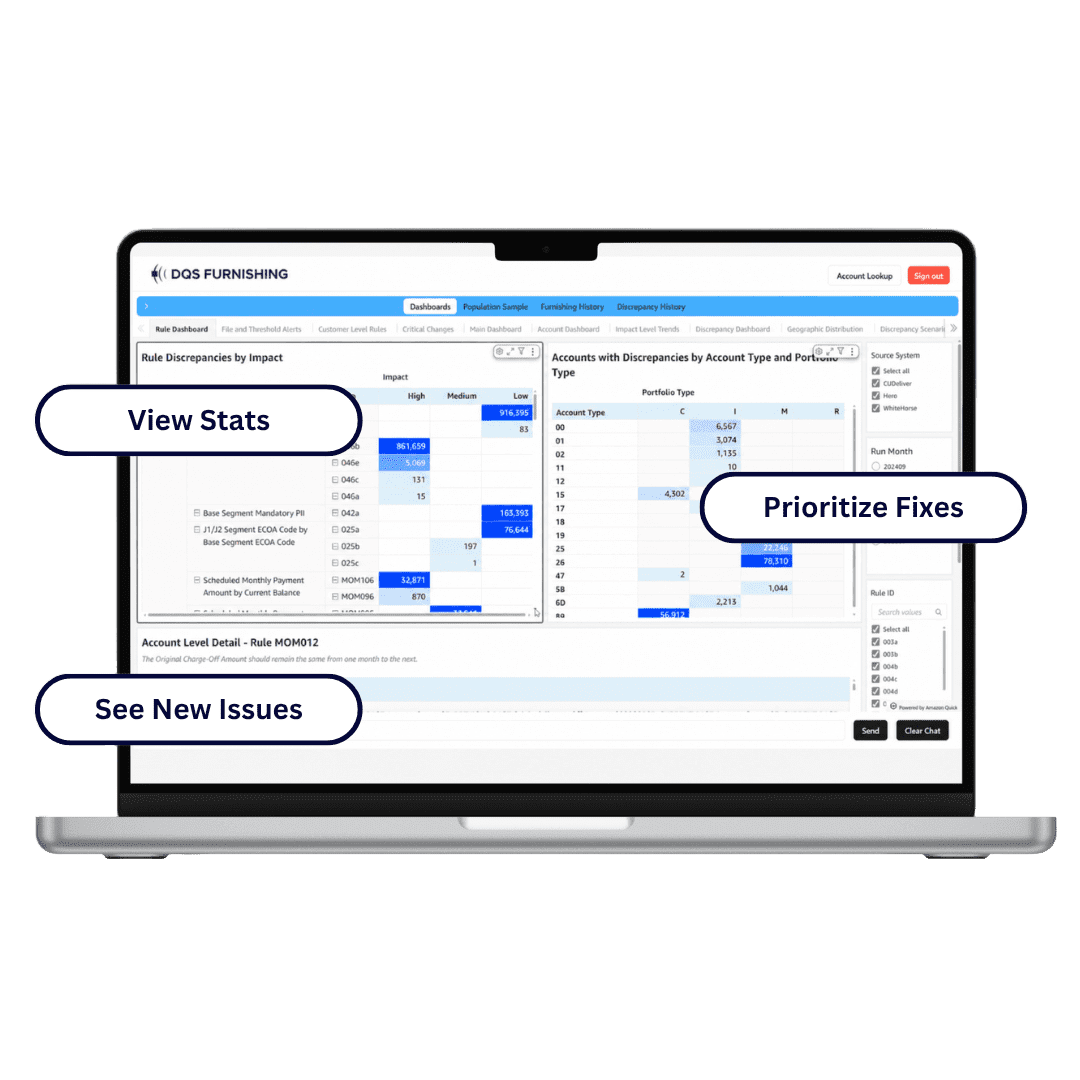
The Furnishing Module helps student lenders and servicers evaluate Metro 2® credit reporting accuracy across long-history accounts, payment history, standard and income-driven repayment status changes, deferment, forbearance, delinquency and default-related reporting, servicing transfers, and other reporting transitions. It monitors 100% of furnished data using over 400 risk-ranked rules and alerts, helping teams identify discrepancy patterns, affected borrower populations, field-level issues, and correction priorities.
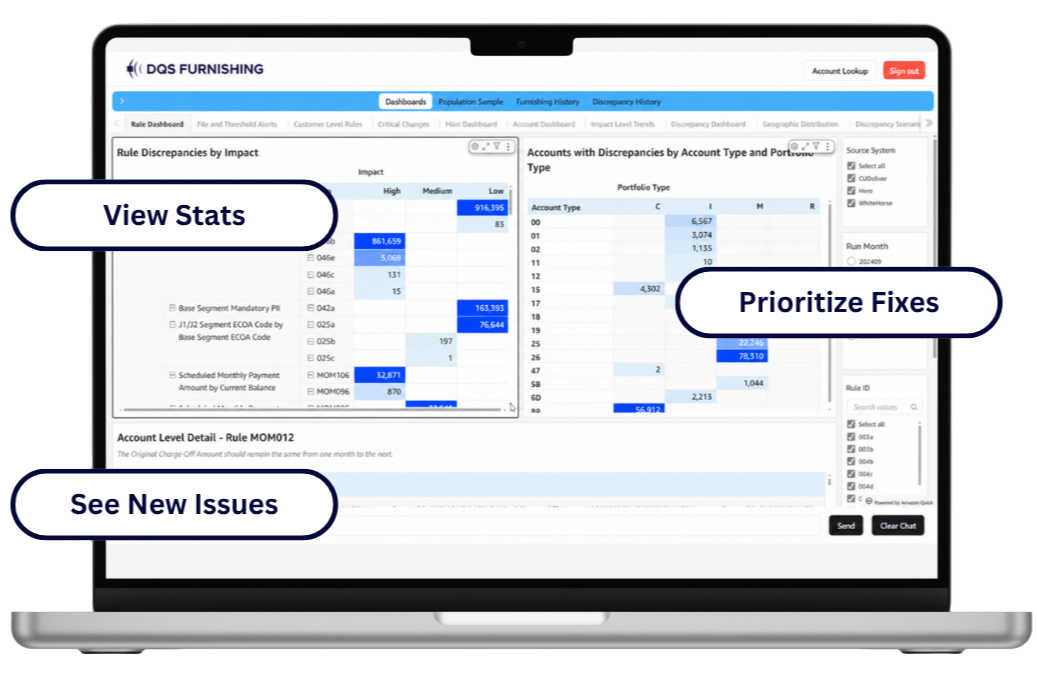
Find
Surface Metro 2® discrepancy patterns across long-history accounts, repayment plans, deferment, forbearance, payment history, and affected borrower populations.
Prioritize
Understand which rules, fields, account groups, status changes, servicing transfers, and reporting periods should be reviewed first.
Fix
Support correction planning, servicing review, documentation review, and compliance follow-up with clearer issue history and population-level context.
New Release Furnishing Module Optional AI Research Assistant add-on available for deeper furnishing investigation.

BUILT ON PROVEN DQS FOUNDATION

These documented Data Quality Scanner outcomes establish the proven foundation behind DQS for student lending furnishing accuracy, full-population monitoring, and dispute oversight.

Rules & Alerts
400+

Risk-ranked rules and alerts across Metro 2® furnishing data quality

Furnishing Monitoring
100%

Furnished data monitoring across the full reporting population

Furnishing Accuracy
90%

Up to 90% reduction in furnishing discrepancies

Dispute Oversight
100%

Full-population dispute oversight beyond manual sampling alone

Dispute Quality
80%

Up to 80% reduction in unresolved dispute discrepancies

Based on documented outcomes. Results vary by institution, operating model, and scope.

Discuss Product Fit for Student Lending Credit Reporting and Dispute Oversight

Student lenders and servicers need a clearer way to review credit reporting and dispute oversight across long account histories, repayment-status changes, deferment and forbearance periods, servicing transfers, rehabilitation activity, and changing payment obligations.

Bridgeforce Data Solutions can discuss furnishing accuracy, dispute-response quality, unresolved corrections, documentation gaps, and account-history patterns and where Data Quality Scanner may support stronger student lending oversight.

Discuss Product Fit

Share your current credit reporting or dispute oversight priorities, and we’ll follow up with next steps.

We do not sell or share your information.

Why the Market Has Changed

Student lending credit reporting now operates across longer account histories, more repayment-status transitions, servicing changes, and higher documentation expectations. That makes consistent review across furnishing and disputes harder to maintain through sampling and disconnected records alone.

FCRA lawsuits and complaint activity are rising across the credit reporting market, increasing the need for clearer furnishing oversight, dispute-response quality, and documentation control.

Metro 2® furnishing issues, bureau changes, unresolved corrections, and response-quality gaps can create repeat disputes, escalations, operational drag, and legal exposure when account history is difficult to explain.

Standard and income-driven repayment changes, deferment, forbearance, delinquency, default-related reporting, and other status transitions can create complex month-over-month reporting patterns.

Servicing transfers can separate current reporting from earlier account history, making source alignment, correction tracking, and documentation review more difficult across systems and vendors.

Templated and AI-assisted dispute submissions are increasing review volume and noise, while teams still need consistent evidence review and human-controlled response decisions.

FCRA LAWSUITS
8,000 6,000 4,000 2,000 0 2014 2017 2020 2023 2025 FCRA litigation continues to rise
FCRA RELATED COMPLAINTS
6 MM 4 MM 2 MM 0 2020 2022 2024 2025 FCRA complaint pressure continues to rise across CFPB and FTC
Sources: WebRecon; CFPB Consumer Response Annual Reports; FTC Consumer Sentinel Data Book; 2024 CFPB Student Loan Ombudsman Report.

The Core Problem

Student lending teams need to connect years of account history with current furnishing and dispute activity. The practical challenge is answering three questions: what changed, what is driving the issue, and what should be reviewed first.

What Changed
Teams need to see which accounts or borrower populations are affected and whether the issue is tied to repayment status, deferment, forbearance, payment history, a servicing transfer, or reporting logic.
What Is Driving the Issue
Teams need to identify which rules, fields, status transitions, historical records, transfer events, or documentation gaps are contributing to the pattern.
What Should Be Prioritized First
Managers need population-level context so furnishing review, dispute follow-up, documentation work, and correction handling can focus on the most material issues first.

When account history, servicing records, furnishing data, and dispute results remain disconnected, student lending teams spend too much time reconstructing context. That slows root-cause review, weakens correction tracking, and limits management visibility across servicing, compliance, credit reporting, and dispute operations.

Common Student Lending Use Cases

Data Quality Scanner helps student lenders and servicers review credit reporting and dispute quality across long account histories, repayment transitions, servicing transfers, documentation, and affected borrower populations.

1

Repayment Status and Account-History Review

Review Metro 2® furnishing accuracy across payment history, standard and income-driven repayment changes, delinquency or default-related reporting, and affected borrower populations.

2

Deferment and Forbearance Reporting

Identify patterns tied to deferment and forbearance periods, status transitions, payment-history treatment, unresolved corrections, and furnished-versus-bureau-reported differences.

3

Servicing Transfer and History Alignment

Compare reporting before and after servicing transfers to surface gaps in account history, status continuity, documentation, correction ownership, and affected populations.

4

Dispute Documentation and Response-Quality Review

Review unresolved corrections, repeat dispute patterns, evidence consistency, account history, servicing documentation, and response quality across the full disputed-account population.

Where separately enabled, the optional premium AI Research Assistant can support furnishing investigation and account-level research. The AI Resolution Engine can support dispute evidence assembly and documentation consistency while in pilot. Human review remains central before corrective action, escalation, or dispute responses move forward.

Student lending oversight
Discuss Product Fit

Ready to discuss how these issues may apply across repayment status, servicing transfers, documentation, and dispute operations?

Current Business Value Across Student Lending Credit Reporting and Dispute Oversight

DQS helps student lenders and servicers strengthen oversight across furnishing accuracy, long account histories, repayment changes, servicing transfers, disputes, documentation, complaint review, and regulatory readiness.

  • Earlier visibility into Metro 2® furnishing issues across long-history accounts, reporting periods, and affected borrower populations
  • Full-population dispute oversight across disputed accounts, analyst responses, unresolved corrections, repeat issues, and documentation gaps
  • Clearer review of standard and income-driven repayment changes, deferment, forbearance, delinquency and default-related reporting, and payment-history continuity
  • Stronger servicing-transfer review through clearer visibility into pre-transfer history, post-transfer reporting, corrections, and ownership
  • Better complaint and regulatory review readiness through clearer documentation, evidence of review, correction status, and account-level context
  • Population-level prioritization that helps teams focus investigation, escalation, and corrective action on the most material patterns

Student lending teams remain responsible for reviewing findings, validating priorities, and directing corrective action under their own compliance, servicing, and credit reporting standards.

Frequently Asked Questions

How does DQS support student lenders and servicers?

DQS helps student lenders and servicers review Metro 2® furnishing accuracy and dispute-response quality across long-history student loan accounts.

It connects population-level monitoring with account-level context across repayment status changes, deferment, forbearance, servicing transfers, documentation, and repeat disputes.

Student lending teams retain responsibility for findings, decisions, escalation, and corrective action under their own compliance and servicing standards.

How can DQS support long-history student loan reporting?

The Furnishing Module monitors 100% of furnished data using over 400 risk-ranked rules and alerts.

Student lending teams can review rule patterns across historical reporting periods, payment history, account status, and affected borrower populations instead of relying on limited samples alone.

The optional premium AI Research Assistant can add account lookup and plain-English research support for deeper historical investigation where separately enabled.

How can DQS help review repayment status changes?

DQS helps teams compare standard and income-driven repayment status, payment history, reporting periods, and related Metro 2® fields across affected accounts.

This can surface inconsistent transitions, month-over-month patterns, unresolved corrections, and populations that require deeper review.

DQS supports investigation and prioritization; student lending teams remain responsible for interpreting findings and directing corrections.

How can DQS help with deferment and forbearance reporting?

Deferment and forbearance can affect repayment status, payment history, scheduled payment information, and month-over-month account progression.

DQS helps teams identify furnishing patterns and discrepancies across the relevant account population and reporting periods.

This gives servicing, compliance, and credit reporting teams clearer context for documentation review, correction handling, and follow-up.

How can DQS support servicing transfer review?

Servicing transfers can make it difficult to align historical reporting, current account status, correction ownership, and supporting documentation across systems or vendors.

DQS helps teams compare reporting patterns before and after a transfer and identify affected populations, unresolved corrections, and furnished-versus-bureau-reported differences.

The resulting visibility supports transfer follow-up, documentation review, and escalation without replacing the servicer’s control process.

How does DQS support dispute documentation and response quality?

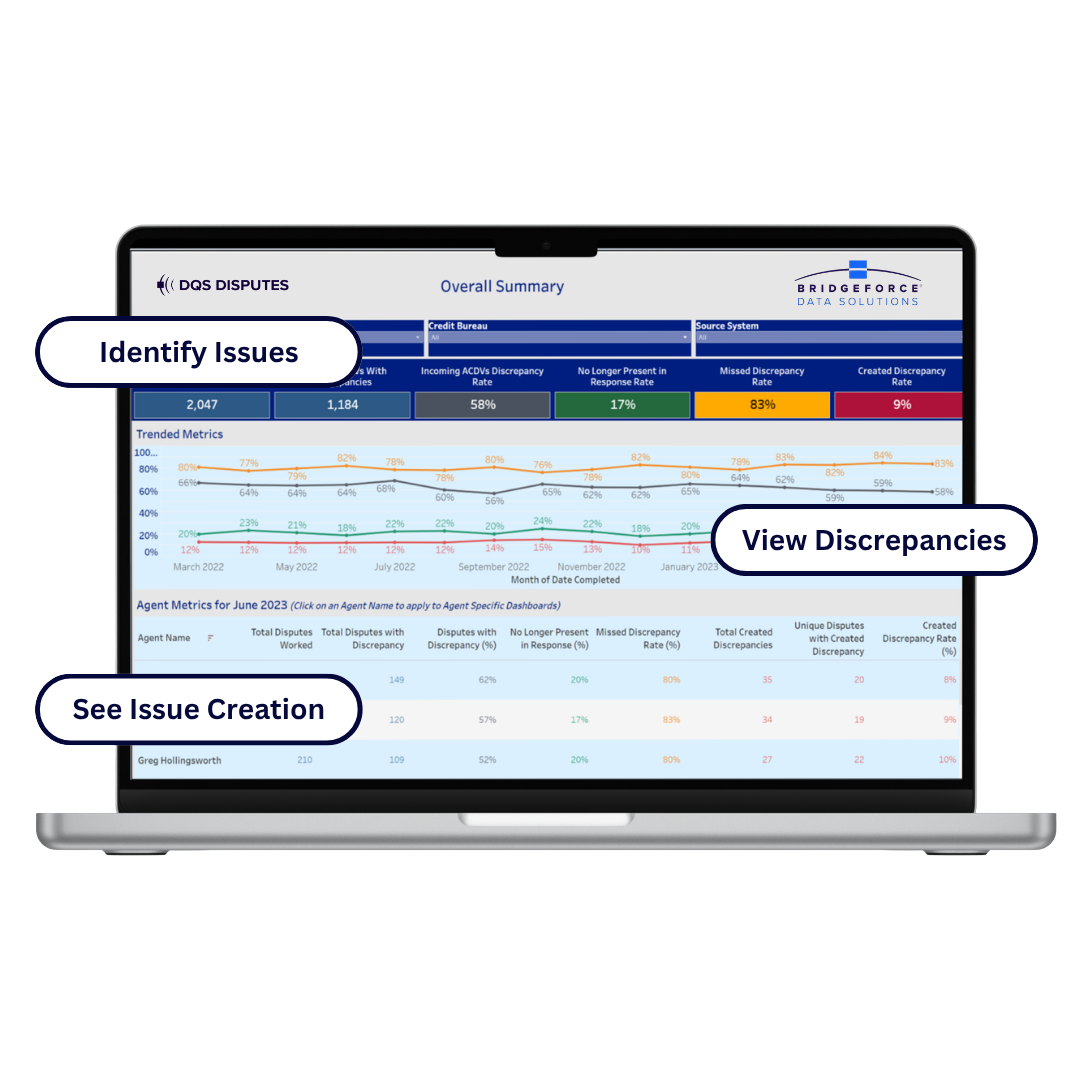
The Disputes Module reviews every disputed account and dispute analyst response using DQS rules, Metro 2®, ACDV, and AUD data.

It helps surface unresolved corrections, response-created discrepancies, bureau transformation issues, repeat dispute patterns, and documentation gaps across the full disputed-account population.

This supports more consistent management review, coaching, correction follow-up, complaint review, and regulatory review preparation.

How does the AI Resolution Engine support student lending dispute review?

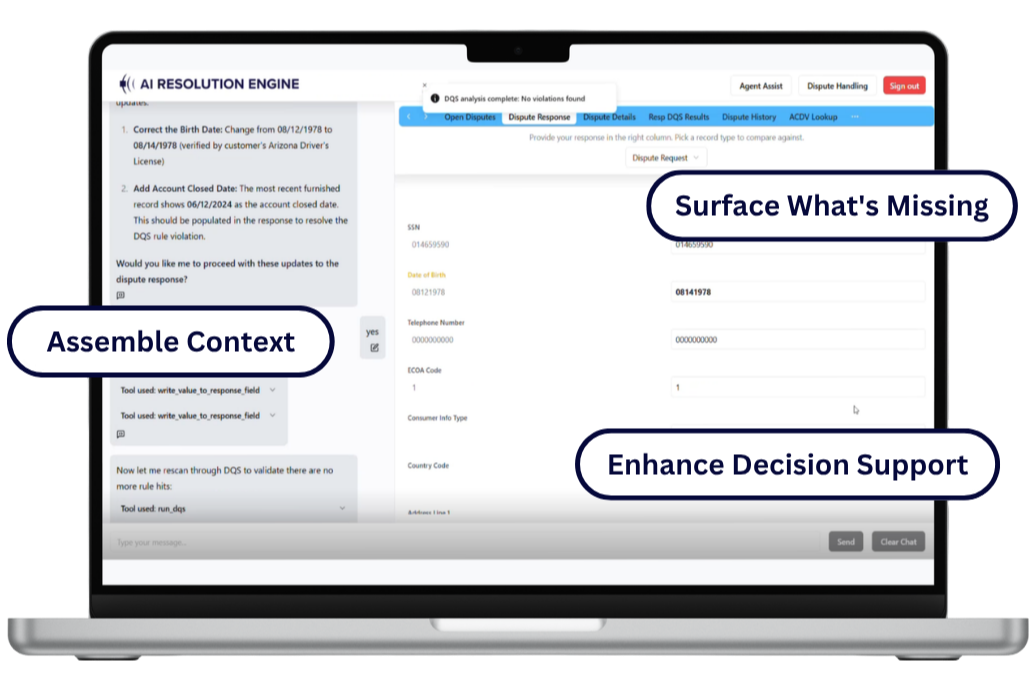
The AI Resolution Engine extends proven DQS intelligence into the dispute-resolution process itself.

It brings together dispute history, furnishing events, supporting documentation, images, procedures, and DQS data and rules to help teams assemble case context, surface evidence gaps, and support more consistent dispute handling before responses are submitted.

The AI Resolution Engine is currently in pilot. It is designed as analyst-facing decision support, and human oversight remains central to review, approval, and dispute-response decisions.

Can DQS support complaint and regulatory review readiness?

DQS provides issue history, affected-population context, correction status, dispute-response findings, and documentation indicators that teams can use during complaint, audit, or regulatory review preparation.

That visibility can help servicing, compliance, risk, quality-control, and regulatory affairs teams explain what was reviewed, what remains open, and where follow-up is required.

DQS supports review and documentation; it does not provide legal conclusions or guarantee compliance outcomes.

Is DQS a heavy IT implementation for student lenders and servicers?

No. DQS is designed as a specialized credit reporting and dispute oversight solution, not a broad platform replacement.

The exact implementation path depends on the organization’s data environment, servicing model, transfer arrangements, reporting process, dispute process, and documentation needs.

The right next step is a product-fit discussion focused on furnished data, account history, servicing transitions, dispute handling, and oversight priorities.

Who DQS Is Designed For Across Student Lending and Servicing

01

Credit Reporting & Dispute Operations Leaders

Credit reporting leaders, dispute operations leaders, FCRA/QC owners, credit bureau reporting managers, dispute managers, and reporting analysts.

Full-population visibility across furnished and disputed student loan accounts, with clearer Metro 2® issue patterns, response-quality review, affected populations, and correction priorities.

02

Servicing Operations & Transfer Oversight Leaders

Student loan servicing leaders, transfer oversight teams, vendor-supported servicing managers, operations leaders, and quality assurance teams.

Clearer review across repayment status changes, deferment, forbearance, account-history continuity, servicing transfers, correction ownership, and documentation follow-up.

03

Compliance, Risk, QA & Regulatory Affairs Leaders

Compliance leaders, operational risk leaders, legal and compliance operations, internal controls, quality-control leaders, and regulatory affairs teams.

Stronger documentation, repeat-issue tracking, complaint and regulatory review readiness, and evidence of consistent oversight across furnishing, servicing, and disputes.

04

Executive & Portfolio Leaders

Senior servicing leaders, credit executives, risk executives, operations executives, portfolio owners, and leaders responsible for student lending oversight strategy.

Portfolio-level visibility into reporting risk, servicing transitions, dispute trends, documentation gaps, correction priorities, and governed analyst-facing support—with human control remaining central.

Discuss Student Lending Credit Reporting and Dispute Oversight

Bring your current furnishing, dispute, servicing-transfer, and documentation priorities. The conversation can focus on where issues are hardest to see, which borrower populations require attention, and which DQS modules align with your environment.

Bridgeforce Data Solutions can discuss product fit across long account histories, repayment-status changes, full-population monitoring, correction handling, and complaint or regulatory review preparation.

Where enabled, the AI Research Assistant supports account research and furnishing-pattern review, while the AI Resolution Engine supports dispute analysis and evidence assembly. Student lending teams retain control over all findings and corrective actions.

What You Can Review
  • Metro 2® furnishing discrepancy patterns
  • Repeat disputes and response-quality concerns
  • Standard and income-driven repayment, deferment, forbearance, and payment-history patterns
  • Servicing-transfer differences, documentation gaps, and affected borrower populations

Discuss Product Fit

Share your furnishing, dispute, servicing-transfer, documentation, or review priorities, and we’ll follow up with practical next steps.

We do not sell or share your information.