
The End-to-End Accuracy Solution for Fintech Credit Reporting and Dispute Controls
Data Quality Scanner helps fintechs strengthen credit reporting and dispute controls across Metro 2® furnishing accuracy, dispute-response quality, and bureau reporting readiness as portfolios grow, products launch, and partner-bank expectations increase.
By connecting furnishing oversight with dispute review, DQS helps fintech teams identify integration-driven discrepancies, data-mapping issues, repeat disputes, and reporting gaps before they spread, with human-controlled review and AI-assisted research or dispute support where enabled.
- Furnishing Complexity Metro 2® issues can spread across products, fields, integrations, and account populations as fintech programs grow.
- Dispute Pressure Repeat disputes and response-quality gaps need review beyond manual sampling alone.
- Portfolio Growth As portfolios grow, small furnishing or dispute issues can affect more accounts and become harder to isolate.
- Product Launches New products and partner-bank programs can introduce reporting rules and field-mapping issues that need review.
- Reporting Readiness Fintech teams need clearer visibility into bureau setup, Metro 2® mapping, furnishing controls, and dispute readiness.
Data Quality Scanner
How the DQS Product Family Supports Fintechs
Furnishing Oversight and Data-Quality Review Across Fintech Products, Integrations, and Reporting Programs
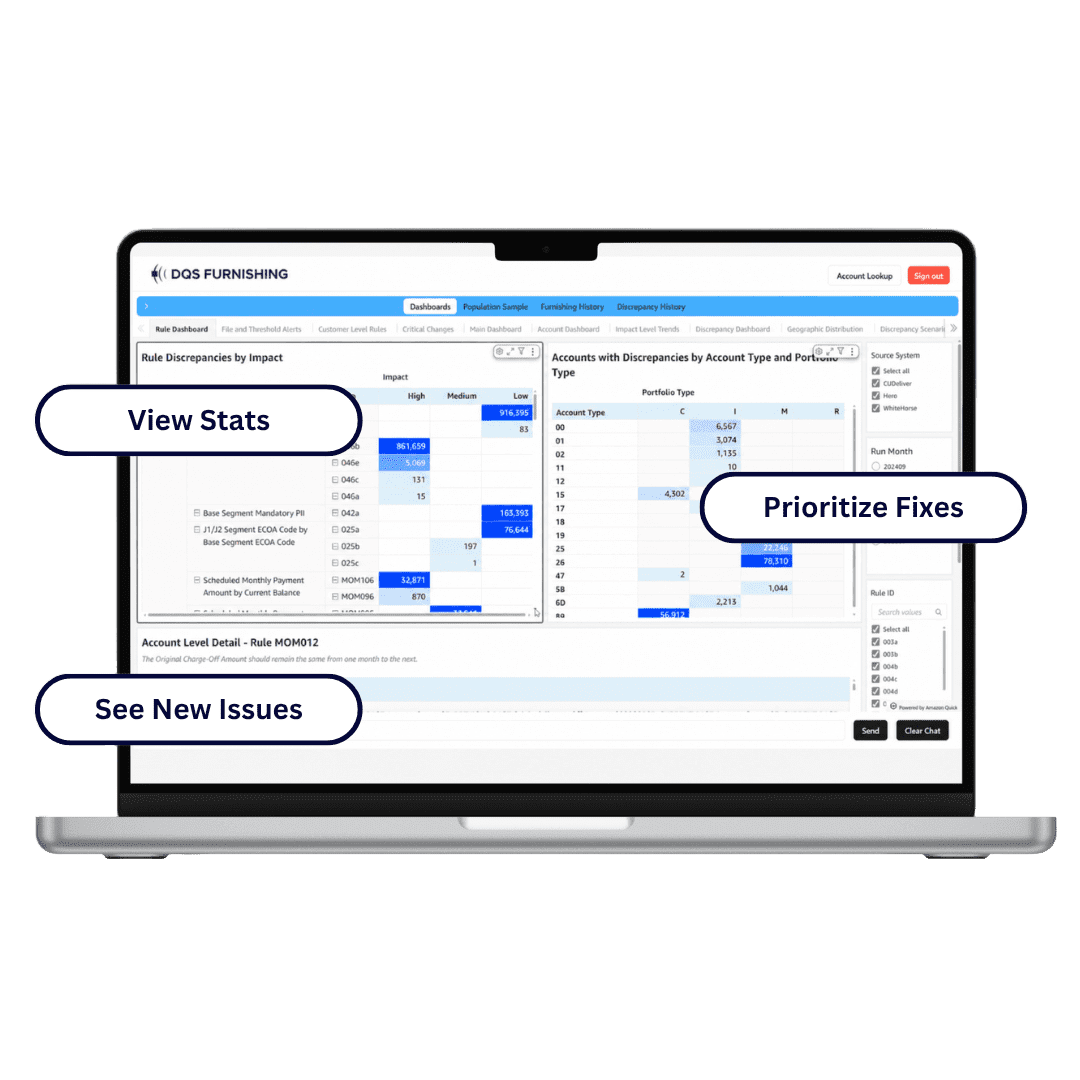
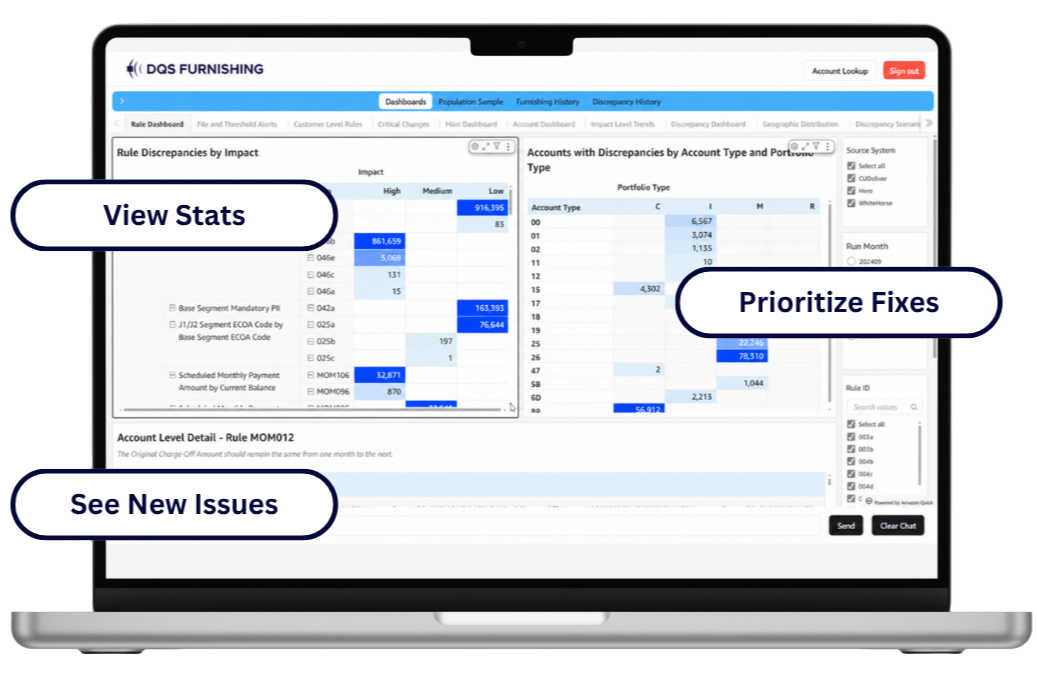
The Furnishing Module helps fintech teams evaluate Metro 2® credit reporting accuracy across furnished accounts, products, integrations, field mappings, and growing reporting populations. It inspects 100% of furnished data using over 400 risk-ranked rules and alerts, helping teams identify discrepancy patterns, affected accounts, reporting gaps, and data-quality issues that may need review before product launches, partner-bank reviews, or bureau reporting issues expand. Optional AI-assisted research can support deeper investigation where enabled.
Dispute Oversight and Response-Quality Review Across Fintech Dispute Operations
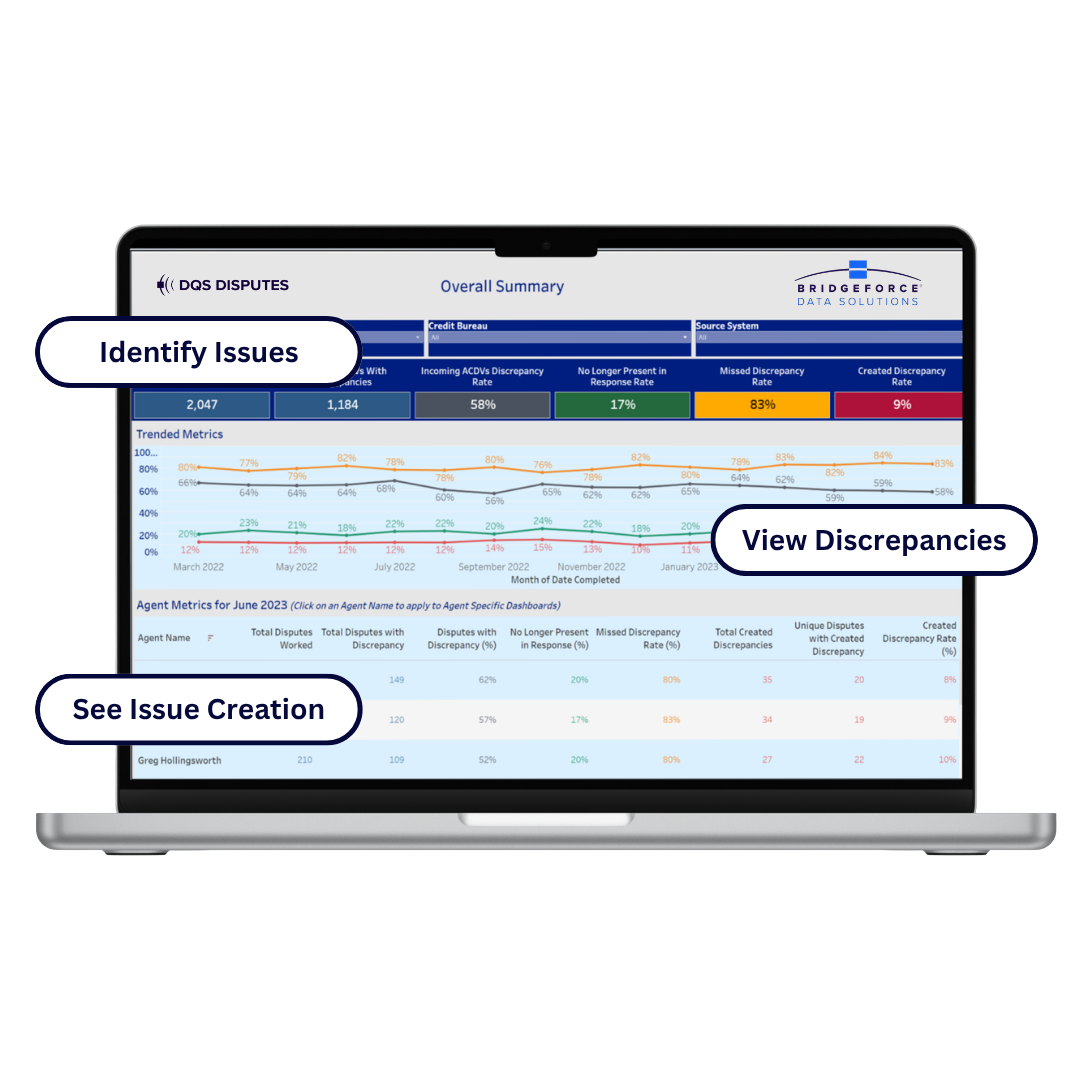
The Disputes Module helps fintech teams evaluate every disputed account and dispute analyst response for data quality and response quality. It surfaces unresolved corrections, analyst-created discrepancies, repeat dispute patterns, differences between furnished and bureau-reported data, and response-quality gaps that can create rework, complaints, partner-bank questions, or reporting-control concerns.
AI-Assisted Dispute Review for Fintech Teams Managing Scale and Consistency
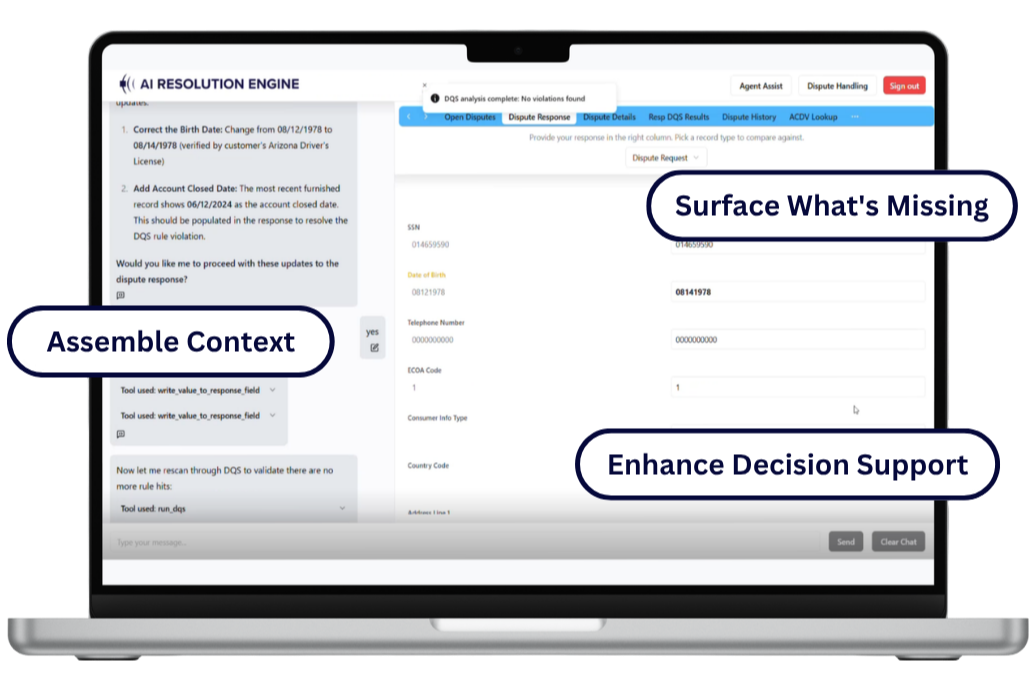
The AI Resolution Engine supports fintech dispute teams by assembling dispute history, documentation, images, procedures, and DQS findings into a more complete case view before responses are submitted.
As dispute submissions become more complex, repeated, and documentation-heavy, the AI Resolution Engine helps teams review evidence, identify missing or conflicting information, and support more consistent dispute handling across growing account populations.
It is designed as analyst-facing decision support for response-quality review, documentation consistency, and more controlled dispute handling. Fintech teams retain review authority while AI-assisted capabilities support approved procedures, evidence review, and documented decision-making.
BUILT ON PROVEN DQS FOUNDATION
These documented Data Quality Scanner outcomes show the proven foundation behind DQS for fintech furnishing accuracy, full-population monitoring, and dispute oversight.
Risk-ranked rules and alerts across Metro 2® furnishing data quality
Furnished data monitoring across the full reporting population
Up to 90% reduction in furnishing discrepancies
Full-population dispute oversight beyond manual sampling alone
Up to 80% reduction in unresolved dispute discrepancies
Based on documented outcomes. Results vary by institution, operating model, and scope.
Discuss Product Fit for Fintech Credit Reporting and Dispute Readiness
Fintech teams launching credit-builder, BNPL, subprime, and other lending products need a clear way to review furnishing accuracy, dispute readiness, data mapping, bureau reporting, and partner-bank expectations before growth makes issues harder to isolate.
Bridgeforce Data Solutions can discuss your furnishing accuracy, dispute readiness, data-mapping logic, bureau reporting setup, partner-bank requirements, and AI-assisted review priorities and where Data Quality Scanner may support stronger credit reporting and dispute control.
Discuss Product Fit
Share your current reporting priorities, growth plans, or integration concerns, and we’ll follow up with next steps.
Why the Market Has Changed
Fintech teams are under pressure to keep credit reporting controls aligned with growth, product launches, integrations, and partner-bank expectations. As FCRA lawsuits, complaint activity, dispute pressure, and AI-driven submissions continue to rise, teams need clearer visibility into what changed, where issues are concentrated, and what should be reviewed first before scale makes issues harder to isolate.
FCRA lawsuits and complaint activity are rising across the credit reporting market, increasing the need for clearer furnishing oversight, dispute-response quality, and documentation control.
Metro 2® furnishing issues, bureau changes, unresolved corrections, and response-quality gaps can create repeat disputes, operational drag, partner-bank questions, and legal exposure.
Fast-moving products, platform integrations, and data-mapping changes can create reporting gaps that spread across accounts, fields, systems, and bureau reporting outputs before teams see them.
Partner banks, investors, and internal risk or compliance teams need clearer evidence that furnishing controls, bureau setup, and dispute readiness are keeping pace with portfolio growth.
AI-driven and templated dispute submissions are increasing, adding volume and noise while making evidence review, documentation, and response-quality consistency harder to maintain at scale.
The Core Problem
Fintech teams need to identify credit reporting data-quality issues before growth, integrations, partner-bank reviews, product launches, dispute volume, or compliance pressure make them harder to isolate. The practical challenge is answering three questions across furnishing and dispute activity: what changed, what is driving the issue, and what should be prioritized first.
When reporting controls are too static or difficult to navigate, fintech teams spend too much time finding the issue and not enough time isolating root cause, validating data maps, reviewing documentation, and prioritizing correction. That raises operating cost, slows launch or scale readiness, and limits visibility across products, integrations, partner-bank expectations, and dispute operations.
Common Fintech Use Cases
Data Quality Scanner helps fintech teams strengthen credit reporting controls as products launch, integrations change, portfolios scale, and partner-bank expectations increase — across Metro 2® furnishing accuracy, bureau reporting readiness, dispute-response quality, and AI-assisted review where enabled.
New Product Launch and Bureau Reporting Readiness
Review Metro 2® furnishing setup, bureau reporting readiness, rule patterns, and affected account populations before new products or reporting changes create harder-to-isolate issues.
Integration and Data-Mapping Issue Detection
Identify integration-driven data-mapping gaps, field-level discrepancies, and recurring reporting patterns across systems, products, accounts, and bureau reporting outputs.
Portfolio Growth and Partner-Bank Reporting Visibility
Monitor furnishing accuracy, issue concentration, correction status, and repeat patterns as portfolios grow and partner-bank, investor, or internal risk expectations increase.
Dispute Readiness and AI-Assisted Review
Review dispute-response quality, unresolved corrections, repeat dispute patterns, documentation, and evidence consistency across the full disputed-account population.
Where enabled, the AI Research Assistant can support furnishing investigation, account-level research, and faster field-by-field review, while the AI Resolution Engine can support dispute evidence assembly, documentation, and response-quality consistency. Human review remains central before corrective action, dispute responses, or remediation priorities move forward.
Review how Data Quality Scanner may support product launches, system integrations, portfolio growth, partner-bank visibility, and fintech dispute operations.
Current Business Value for Fintechs
DQS helps fintech teams scale credit reporting controls across Metro 2® furnishing accuracy, integrations, bureau setup, partner-bank expectations, new product launches, dispute readiness, and AI-assisted review where enabled.
Fintech teams remain responsible for reviewing findings, validating priorities, directing corrective action, and deciding how furnishing and dispute-response issues should be handled within their own compliance, partner-bank, product, and operational standards.
Frequently Asked Questions
How does DQS support fintechs?
DQS helps fintechs strengthen furnishing and dispute controls as products, portfolios, integrations, and reporting populations scale.
By connecting Metro 2® furnishing review with dispute oversight, DQS helps product operations, risk operations, compliance, data, and credit reporting teams see what changed, where issues are concentrated, and what should be reviewed first.
Fintech teams remain responsible for reviewing findings, validating priorities, directing corrections, and managing decisions within their own compliance, partner-bank, product, and operational standards.
How does DQS help fintechs with Metro 2® furnishing accuracy as portfolios scale?
The Furnishing Module helps fintechs review Metro 2® data quality, rule patterns, affected populations, and root-cause indicators across furnished accounts.
It inspects 100% of furnished data using over 400 risk-ranked rules and alerts, helping teams identify discrepancies tied to products, fields, source systems, integrations, reporting logic, bureau setup, or reporting outputs.
For fintech teams that need deeper account-level investigation, the optional premium AI Research Assistant adds account lookup screens and plain-English research support to help users investigate discrepancies and related patterns more efficiently.
How can DQS support new product launches and bureau reporting readiness?
DQS can help fintech teams review furnishing logic, data quality patterns, affected populations, and reporting readiness before or after a new product launch.
This is especially important when a fintech is adding new credit products, changing platform logic, expanding bureau reporting, or preparing partner-bank stakeholders for broader scale.
Instead of waiting for reporting issues to show up later through disputes, complaints, or partner-bank questions, DQS gives teams a clearer way to identify what changed, which populations are affected, and which items should be reviewed first.
How does DQS help identify integration and data-mapping discrepancies?
Fintech reporting environments often depend on multiple source systems, product configurations, partner integrations, data mappings, bureau setup decisions, and reporting outputs.
DQS helps surface discrepancy patterns that may be tied to integration changes, field logic, product setup, data mapping, or reporting transformations.
That gives fintech teams clearer direction on what to investigate first and helps reduce the risk that small integration issues become broader furnishing, dispute, or partner-bank review problems.
How does DQS support partner-bank confidence and reporting oversight?
DQS gives fintech teams clearer visibility into issue history, rule patterns, affected populations, correction status, and dispute-response patterns.
That helps product, compliance, risk, and credit reporting teams support stronger partner-bank conversations with better evidence around reporting controls, documentation, and corrective-action priorities.
DQS does not replace partner-bank governance or fintech compliance review. It helps create a stronger shared visibility layer so teams can identify, prioritize, and document issues more consistently.
How does DQS help fintechs with dispute readiness and dispute-response quality?
The Disputes Module reviews every disputed account and dispute analyst response using DQS rules, Metro 2®, ACDV, and AUD data.
It helps surface unresolved corrections, response-created discrepancies, bureau transformation issues, and repeat dispute patterns so fintech teams can strengthen dispute readiness beyond manual sampling alone.
When paired with the Furnishing Module, the Disputes Module provides a more complete view of how upstream furnishing issues may drive downstream disputes and how those issues are or are not resolved in responses.
How does the AI Resolution Engine support fintech dispute review at scale?
The AI Resolution Engine extends proven DQS intelligence into the dispute-resolution process itself.
It brings together dispute history, furnishing events, supporting documentation, images, procedures, and DQS data and rules to help teams assemble case context, surface evidence gaps, and support more consistent dispute handling before responses are submitted.
The AI Resolution Engine is currently in pilot. It is designed as analyst-facing decision support, and human oversight remains central to review, approval, and dispute-response decisions.
Is DQS a heavy IT implementation for fintechs?
No. DQS is designed as a specialized credit reporting and dispute oversight solution, not a broad platform replacement.
The exact implementation path depends on the fintech’s data environment, reporting process, product scope, partner-bank structure, and integration model.
For fintech teams, the right next step is usually a product-fit discussion focused on data sources, reporting populations, bureau reporting readiness, partner-bank expectations, dispute handling, and integration priorities.
Who DQS Is Designed For at Fintechs
Product Operations & Credit Reporting Owners
Product operations teams, credit reporting owners, bureau reporting managers, product managers, launch teams, and director or manager-level operators responsible for reporting readiness.
Clearer visibility into Metro 2® furnishing accuracy, new product launch readiness, affected populations, reporting changes, and the issue patterns that should be reviewed before portfolio growth creates avoidable rework.
Risk Operations & Compliance Leaders
Risk operations leaders, compliance leaders, FCRA/QC owners, control teams, reporting oversight teams, and operations leaders responsible for scalable credit reporting controls.
Stronger operating control across furnishing and disputes, clearer documentation support, repeat issue tracking, full-population monitoring, and better visibility into reporting risk as products, portfolios, and partner-bank expectations evolve.
Data, Analytics & Integration Leaders
Data leaders, analytics leaders, data operations teams, integration owners, platform operations teams, and reporting teams managing source-system logic, field mapping, and bureau setup.
More consistent visibility into integration-driven discrepancies, data-mapping issues, product configuration changes, bureau reporting outputs, and the rules or fields driving reporting differences across growing account populations.
Partner-Bank, Dispute & Scaling Operations Leaders
Partner-bank program owners, dispute operations leaders, customer operations leaders, scaling operations teams, senior operators, and leaders evaluating AI-assisted review for scale and consistency.
Stronger partner-bank confidence, dispute readiness, response-quality visibility, documentation support, and a controlled path to AI-assisted review where enabled — while human review remains central to decisions and corrective action.
What Fintech Furnishing and Dispute Teams Say
Fintech product, risk, dispute, and credit reporting teams use Data Quality Scanner to strengthen furnishing accuracy, dispute readiness, and reporting control as products launch, portfolios scale, and partner-bank expectations grow.
Fintech Client Feedback“DQS meets our business needs. We get a lot of good insights monthly from the platform, and overall, we’re getting a lot of value from DQS. The support we currently get is great.”
“It takes a rule that can seem nebulous and helps make it come to life.”
“The critical changes information is definitely more detailed. I would see this being helpful for us for sure.”
“DQS 10 digs in a little deeper with those trends and provides more insight. All this looks great.”
Strengthen Fintech Credit Reporting and Dispute Control Across Product Launches, Integrations, and Partner-Bank Review
Data Quality Scanner helps fintech teams review Metro 2® furnishing accuracy, dispute-response quality, data-mapping logic, bureau reporting readiness, and affected account populations across growth, integrations, and new product launches.
For fintech teams managing dispute volume, partner-bank programs, bureau setup, or portfolio growth, Bridgeforce Data Solutions can help support clearer issue history, dispute-readiness visibility, affected-population review, and partner-bank confidence around what should be prioritized first.
Where enabled as an optional premium add-on to the Furnishing Module, the AI Research Assistant can support account research, data-mapping review, and furnishing-pattern analysis. The AI Resolution Engine, currently in pilot, can support dispute context, evidence assembly, documentation consistency, and analyst-facing decision support. Fintech teams retain control over findings, decisions, escalation, and corrective action.
- Metro 2® furnishing discrepancy patterns
- Dispute readiness, response quality, and repeat issue patterns
- Data mapping, bureau setup, and new product readiness
- Issue history, affected populations, and partner-bank confidence
Discuss Fintech Product Fit
Share your furnishing, dispute, integration, or bureau reporting priorities, and we’ll follow up with next steps.