CDIA Connect 2026 exceeded expectations.
As someone who has spent years deep in FCRA, credit reporting, and dispute operations, I found the event to be genuinely valuable because it was clearly designed for practitioners. The conversations were substantive, the panels were highly relevant, and the issues discussed are directly connected to the operational and compliance challenges furnishers, consumer reporting agencies, attorneys, lenders, servicers, fraud teams, and dispute teams are managing every day.
I’d like to thank Dan Smith, Kristine McMahon, and the entire Consumer Data Industry Association team for hosting an exceptionally well run and informative event. We look forward to continuing our participation as Platinum Sponsors throughout the year.
A few themes stood out across the event. Preserving national FCRA standards remains central. Dispute abuse is increasingly becoming a fraud and risk control issue. FCRA litigation pressure continues to rise. AI adoption is nearing an inflection point. And the proposed shift from tri merge to a single bureau mortgage model raises serious questions about accuracy, pricing, consumer outcomes, and market confidence.
Taken together, these issues point to one larger conclusion: credit reporting risk is becoming more connected, more operational, and more urgent.
Five Takeaways from CDIA Connect 2026
The conversations we heard at CDIA Connect centered on five major themes:
- Preserving national FCRA standards remains the central industry issue.
- FCRA litigation pressure and volumes continue to rise.
- Disputes are now a fraud, risk, and compliance control challenge.
- AI adoption is nearing an inflection point.
- Moving from tri-merge to a single bureau mortgage model raises meaningful concerns.
For organizations responsible for furnishing, disputes, fraud, compliance, and credit reporting oversight, these themes are not theoretical. They affect how teams investigate disputes, document decisions, detect abuse, manage litigation risk, and prepare for the responsible use of AI.
Preserving National FCRA Standards Remains the Central Issue
Across multiple panels and conversations, the importance of preserving national standards under the FCRA was clear.
As state level activity accelerates, the risk of eroding FCRA preemption continues to create concern across the industry. A fragmented state by state approach to credit reporting obligations could increase operational complexity, reduce consistency, and make it harder for organizations to maintain clear, defensible processes across jurisdictions.
This is not only a policy issue. It has direct implications for accuracy, consistency, consumer outcomes, and operational control.
For furnishers and consumer reporting agencies, national standards help support a more consistent credit reporting framework. As those standards face pressure, organizations will need stronger internal controls, better documentation, and clearer evidence that their processes are reasonable, repeatable, and consistently applied.
FCRA Litigation Pressure and Volumes Continue to Rise
FCRA litigation was one of the most important themes coming out of CDIA Connect.
Individual FCRA lawsuits continue to outpace class actions, and organizations are facing increasingly sophisticated plaintiff tactics. In many cases, these strategies appear designed to create discovery leverage and attorney fee opportunities rather than resolve the underlying consumer issue as efficiently as possible.
That creates a difficult environment for furnishers, consumer reporting agencies, and other industry participants. Dispute quality, investigation consistency, documentation, and early issue resolution matter more than ever.
If an organization is given the opportunity to resolve a dispute before litigation is filed, getting it right early is critical.
A strong dispute process should help the organization determine what happened, document the basis for the decision, identify whether a correction is needed, and support a reasonable investigation record if the matter is later challenged. Limited documentation or inconsistent handling can create exposure even when the underlying issue could have been resolved earlier.
Litigation readiness starts well before a lawsuit is filed. It begins with the quality of the investigation, the clarity of the decisioning, and the ability to show that the organization followed a reasonable and consistent process.
For organizations facing rising FCRA litigation pressure, getting disputes right early is no longer just an operational goal. It is a risk management priority. Teams need better visibility into investigation quality, documentation, and recurring furnishing issues before a dispute becomes a lawsuit.
Disputes Are Now a Fraud and Risk Control Challenge
Dispute operations were another major focus throughout the event.
Credit washing, abuse of identity theft provisions, and manipulation of intake channels are increasing complexity and raising the bar for defensible investigations. These trends are changing how organizations need to think about dispute handling.
Disputes can no longer be viewed only as a response process. They are now part of a broader fraud, risk, legal, and compliance control environment.
That means teams need to identify patterns, distinguish legitimate consumer issues from coordinated or abusive activity, support consistent investigations, document decisions clearly, and escalate emerging risks before they become larger problems.
The goal is not simply to process disputes faster. The higher value opportunity is to improve investigation quality, identify recurring issues, and create outcomes that can withstand operational, regulatory, and legal review.
AI Adoption Is Nearing an Inflection Point
AI was another major theme across CDIA Connect.
Most organizations are not yet using AI directly in furnishing or dispute operations, but many expect to explore or adopt AI supported capabilities over the next one to two years. At the same time, fraud and dispute abuse are already using AI more aggressively.
That imbalance creates urgency.
During our sponsored lunch, we polled nearly 100 attendees about their biggest concerns related to AI adoption. The top concern, by a wide margin, was trusting AI generated results at 47%. That was followed by risk and compliance at 27%, data readiness at 14%, buy in at 8%, and identifying the right use cases at 3%.
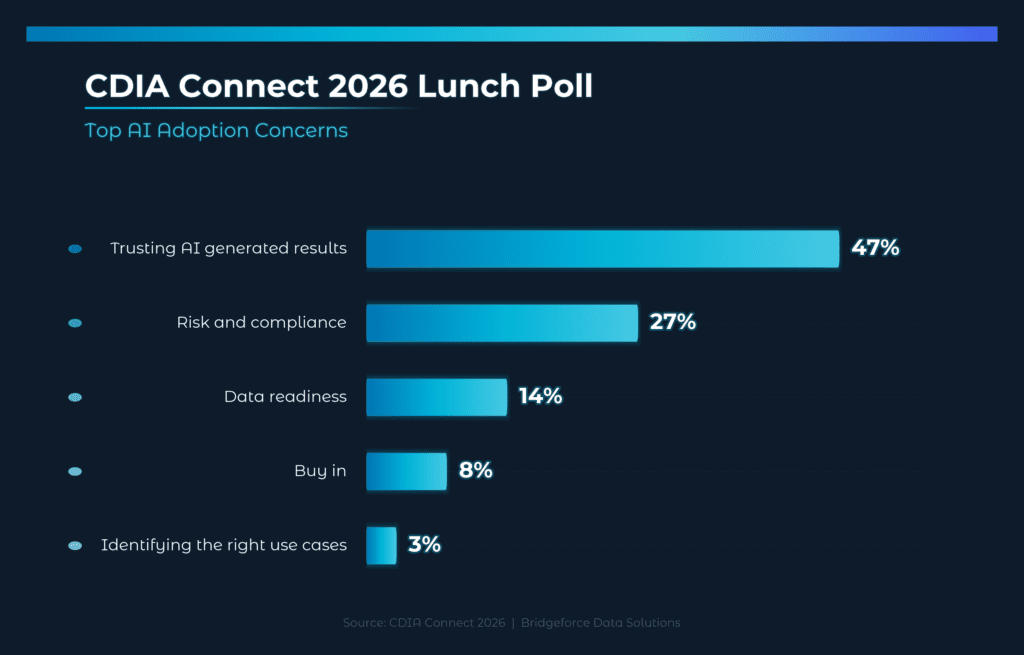
Those results reflect the real issue facing credit reporting and dispute teams. The question is not simply whether AI can generate an answer. The question is whether that answer can be trusted, governed, documented, explained, and used appropriately in a regulated process.
That distinction matters.
For the past two years, we have been focused on building an enterprise-grade AI capability for credit bureau disputes, not repurposing personally available AI tools for business support.
The AI Resolution Engine is designed to support human-controlled dispute resolution by assembling dispute history, furnishing context, client procedures, consumer provided images, and supporting documentation, while surfacing evidence gaps and strengthening structured, documented review processes. It is also designed to support a phased adoption path that may include controlled automated handling for narrowly defined dispute populations under approved governance, controls, and validation standards.
That is why trust, risk, compliance, and data readiness are not side issues. They are the core design requirements. AI in credit reporting and disputes cannot be treated as a generic automation layer. It needs to support controlled, transparent, auditable, and defensible processes that can account for the actual materials consumers provide, including images and documentation.
The right path is governed adoption.
Moving from Tri Merge to a Single Bureau Mortgage Model Raises Real Concerns
The discussion around moving from a tri-merge to a single bureau mortgage model also surfaced significant concerns.
Less data may simplify optics, but it does not necessarily reduce risk. In fact, several participants raised concerns that a single bureau model could create issues related to accuracy, pricing, consumer outcomes, and confidence in the broader mortgage and secondary market ecosystem.
Credit reporting models depend on data depth, consistency, and reliability. Reducing data inputs in a mortgage context could create unintended consequences for consumers, lenders, investors, and the market overall.
A shift of this size should be evaluated carefully. Simplification should not come at the expense of accuracy, fairness, pricing confidence, or secondary market stability.
What This Means for Furnishing, Dispute, Fraud, and Compliance Teams
The themes from CDIA Connect point in the same direction.
Credit reporting and disputes teams are being asked to manage more complexity, more risk, and higher expectations. Furnishers need to maintain accurate data. Dispute teams need to conduct reasonable and consistent investigations. Fraud teams need to detect abuse across channels. Compliance and legal teams need stronger documentation and earlier visibility into potential issues.
That requires more than policies and procedures.
Organizations need practical ways to identify issues earlier, prioritize the matters that create the greatest risk, investigate root causes, document decisions, and maintain strong governance over both human and AI supported processes.
The next phase of credit reporting oversight will require better visibility across the full population of furnishing and dispute activity, not just sample based reviews or reactive issue management.
DQS and AI Supported Capabilities Drew Strong Interest at CDIA Connect
At CDIA Connect, our CEO, Matt Scarborough previewed the new release of the DQS Furnishing Module, including its available Premium AI Research Assistant, along with the in-pilot AI Resolution Engine for Credit Bureau Disputes. These capabilities received very positive reception and interest from attendees focused on furnishing quality, dispute investigation, documentation, litigation readiness, and scalable operational oversight.
That response reinforced what we heard throughout the event. Teams are looking for better ways to identify data quality issues, prioritize risk, investigate root causes, improve dispute outcomes, and strengthen documentation without losing human control or governance discipline.
It also reinforced why enterprise-grade AI matters. In a regulated credit reporting environment, personally available AI tools are not enough. Teams need AI supported capabilities that are purpose-built for the dispute process, informed by proven data quality rules, aligned to client procedures, able to review consumer provided images and supporting documentation, supported by audit trails, and governed through human-controlled review.
The AI Resolution Engine is designed to support that type of governed adoption path. It can begin with human-controlled decision support and may include controlled automated handling for narrowly defined dispute populations, such as duplicate disputes or no-new-information disputes, where permitted by a client’s approved governance, controls, and validation standards.
If your organization is evaluating how to improve furnishing quality, dispute oversight, investigation consistency, litigation readiness, consumer documentation review, or AI supported dispute resolution, we would welcome the opportunity to share a more detailed walkthrough of the next phase of the Data Quality Scanner.
The walkthrough may be especially relevant for teams responsible for furnishing quality, disputes, complaint response, litigation support, compliance monitoring, fraud operations, or second line oversight.
Final Takeaway
CDIA Connect 2026 belongs on the annual calendar for anyone whose work touches credit reporting, disputes, fraud, compliance, or consumer data.
The event made clear that the industry is entering a more complex phase. FCRA preemption is under pressure. Dispute abuse is becoming more sophisticated. Individual litigation risk continues to rise. AI adoption is moving closer to operational reality. And major credit reporting policy changes, including mortgage data simplification, require careful scrutiny.
The organizations best positioned for what comes next will be the ones that invest in stronger visibility, better controls, more consistent investigations, better documentation, and technology that supports sound compliance and operational judgment.